
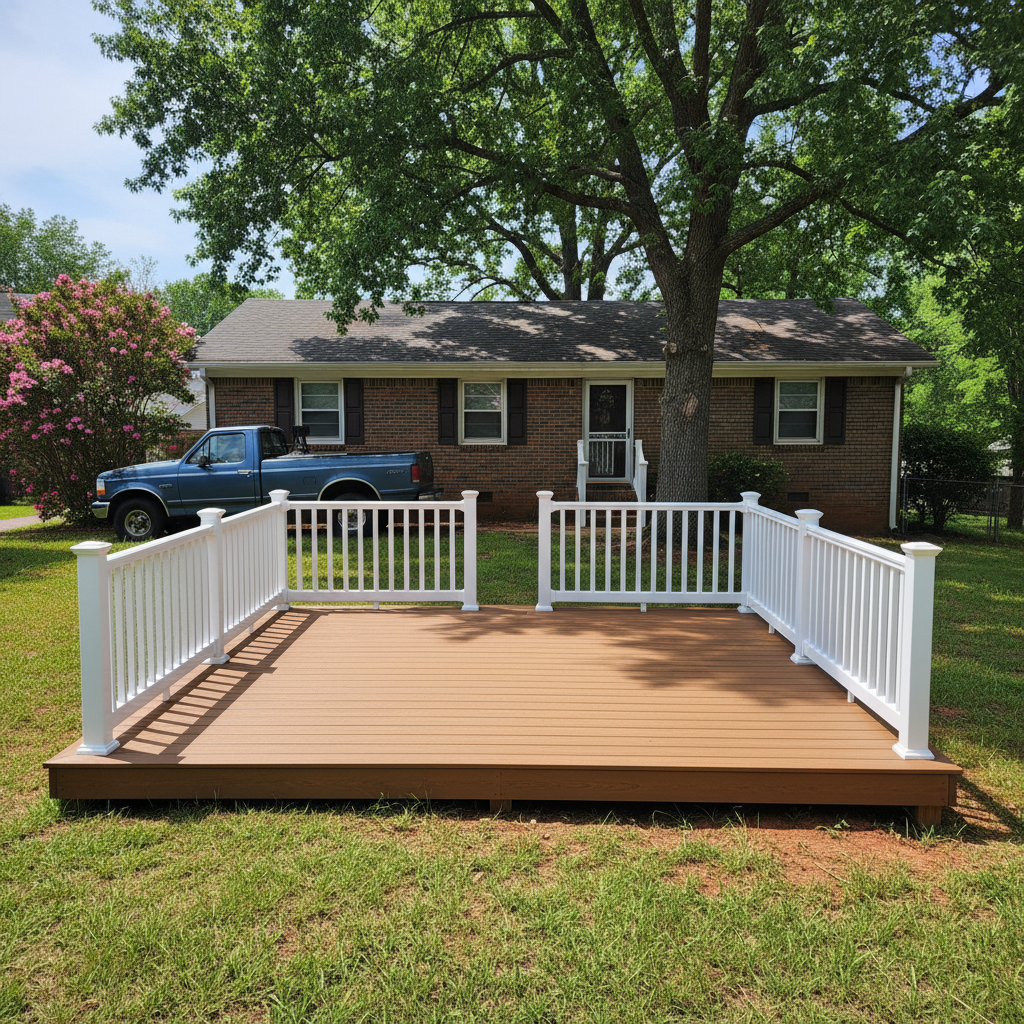
Atlanta has more deck builders than it did ten years ago, and a fair number of them are a truck, a trailer, and a Facebook page. Some of those guys are perfectly good at framing a deck. Some of them don't know what Fulton County's footing inspector is going to look for, and you find that out after the deck is built, not before.
Here's what actually separates a builder worth hiring from one you'll be calling back in three years.
Ask who's pulling the permit
A deck attached to the house, or one more than about 30 inches off grade, needs a building permit in most metro Atlanta jurisdictions, whether that's the City of Atlanta, Fulton, DeKalb, Cobb, or Gwinnett County. The permit process usually means a plan review, a footing inspection before any concrete gets poured, a framing inspection once the joists and ledger are up, and a final. If a builder tells you permits are a waste of time or that your project is too small to need one, that's a guess dressed up as confidence. It's also the first sign they're planning to cut corners somewhere you won't see until the deck is finished.
If you're in a subdivision with an HOA, which covers a lot of ground in places like Johns Creek, Alpharetta, and Peachtree City, there's usually a separate architectural review on top of the county permit. A builder who's worked in your neighborhood before will already know what that board wants to see.
Ask about footing depth, and don't accept a vague answer
Metro Atlanta sits on Piedmont clay. It's dense, it holds water, and it swells and shrinks with the seasons more than people expect for a place that doesn't get hard freezes. Footings that aren't deep enough, or that aren't resting on undisturbed soil, will heave or settle over a few years and take the whole deck frame slightly out of level with them. You'll see it as a railing post that's started to lean, or a door that used to line up with the deck surface and now doesn't.
A good builder can tell you the footing depth they're planning and why, usually 12 inches minimum in most Atlanta-area jurisdictions, sometimes more depending on the soil report and the local code. They should also know that red clay turns to soup after a few days of spring rain, and that pouring footings in standing water is how you end up with a footing that isn't actually bearing on anything solid. If a builder shrugs when you ask about this, that's worth noting.
Look at how the deck attaches to the house
The ledger board, the piece bolted to your house band board that the whole deck hangs off of, is where most deck failures start. It needs through-bolts or structural lag screws, not just nails. It needs flashing that actually sheds water away from the house framing, not caulk smeared along the top edge. Atlanta gets roughly 50 inches of rain a year, often in heavy spring and summer storms, and a poorly flashed ledger will rot the band board behind it slowly enough that nobody notices until the deck starts to pull away from the house.
Ask to see how they flash a ledger. A builder who's done this for years will have an answer in about ten seconds. One who hasn't will talk about caulk.
Material choices that actually matter here
Pressure-treated pine is still the most common frame material in this market, and it's fine for the structure if it's rated for ground contact where it touches footings or sits low to grade. For the decking surface itself, homeowners here are mostly choosing between treated wood, which needs restaining every two to three years in our humidity, and composite, which costs more up front but doesn't need the recoat.
One thing composite does that wood doesn't: it expands and contracts with heat. Atlanta summers push deck surface temperatures well past 120 degrees in direct July sun, and composite boards need gap spacing at the ends and a fastening pattern that accounts for that movement. A builder who installs composite the same way they'd install wood, tight joints, no allowance for expansion, will end up with buckled boards within a season or two.
Red flags worth walking away from
- Full payment, or close to it, requested up front before any work starts. A deposit for materials is normal. The full contract price is not.
- No written contract, or one that doesn't list the lumber grade, fastener type, footing depth, and a start and finish date.
- No mention of a permit, ever, unprompted.
- Can't produce proof of liability insurance when you ask. This one matters more than people think, because if a worker gets hurt on your property and the contractor isn't insured, that liability can land on you.
- A bid that's dramatically lower than everyone else's with no explanation. Usually it means thinner joist spacing, smaller footings, or a plan to skip the permit and the inspections that go with it.
What a good process looks like
A builder worth hiring will walk your lot, check which way the ground slopes, and talk about drainage before they talk about railing style. On a lot with poor grading, water pools under a low deck and keeps the framing damp year-round, which speeds up rot no matter how good the lumber is. They'll also ask about your soil and your lot's age, because a deck going onto a 1930s foundation in Grant Park or East Atlanta is a different job than one going onto a ten-year-old slab in Forsyth County, even if the deck itself looks the same on paper.
They'll give you a written quote that breaks out labor and materials, tell you roughly how many days the framing inspection will add to the schedule, and tell you when you can actually put furniture and foot traffic on the finished deck, which for a freshly poured footing is usually a matter of days, not the full 28-day concrete cure some people assume.
If you want a sense of how we handle footings, ledger attachment, and permits on jobs around Atlanta, our deck builder work is a reasonable place to start comparing notes against whatever quote you've already got in hand.